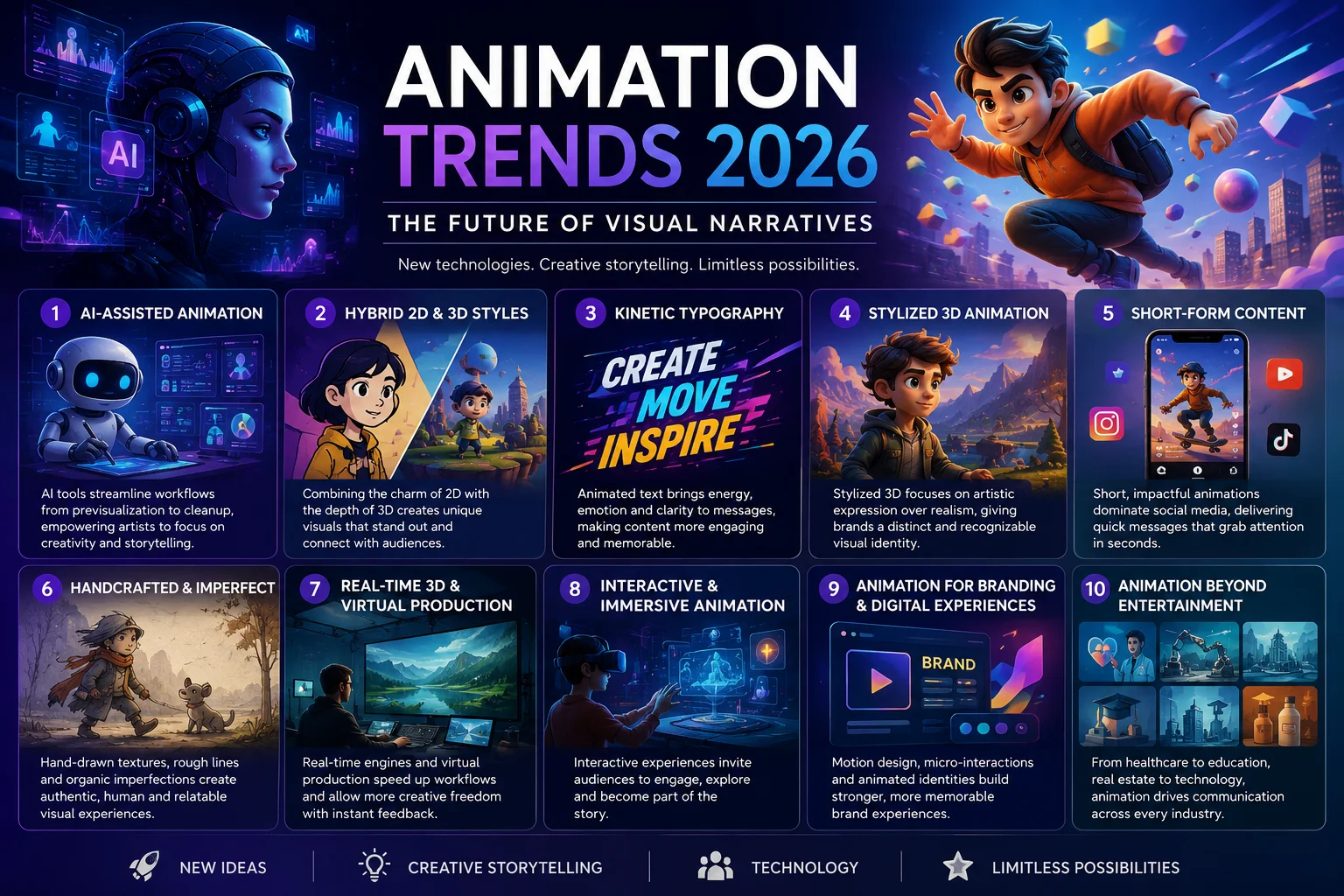

Animation Trends in 2026: AI, 3D & Motion Graphics in the USA
Animation is moving into a new phase in 2026. AI-assisted production, 3D visualization, real-time rendering, hybrid 2D/3D workflows, and short-form motion content are changing how brands, studios, and creative teams approach animated content.
The shift is especially important in the U.S. market, where animation is being used far beyond traditional film and television. Businesses are increasingly using animation for advertising, product visualization, healthcare, education, gaming, architecture, and digital experiences.
1. AI-Assisted Animation Is Becoming Part of the Production Pipeline

Artificial intelligence is no longer simply an experimental technology for animation teams.
In 2026, AI is increasingly being used to assist with tasks such as the following:
- Concept development
- Character and asset creation
- Automated rigging
- Motion generation
- Background development
- Rotoscoping
- Rendering assistance
- Upscaling
- Production iteration
The important trend is not necessarily replacing artists with AI. Instead, AI is increasingly being integrated into production pipelines to reduce repetitive work and accelerate iteration.
2. 3D Animation Is Expanding Beyond Entertainment

3D animation remains one of the most important areas of growth.
Businesses are using 3D animation to demonstrate things that are difficult to communicate through traditional photography or live-action video.
Examples include:
- Product demonstrations
- Medical visualization
- Architectural visualization
- Industrial processes
- SaaS product visualization
- Engineering concepts
- Training simulations
- Advertising
- Gaming assets
This makes 3D animation services increasingly relevant to companies that need to explain complex products or processes.
3. Hybrid 2D + 3D Animation Is Gaining Attention

The debate between 2D and 3D animation is becoming less important.
Modern productions can combine both approaches.
For example, a marketing video might use the following:
2D storytelling + 3D product visualization + motion graphics + typography
This hybrid approach allows creative teams to choose the right visual technique for each part of the story instead of forcing the entire project into one animation style.
It can be particularly useful for technology companies, healthcare brands, SaaS businesses, educational platforms, and product companies.
4. Real-Time Rendering Is Changing Animation Workflows

Real-time rendering is another major development in modern animation.
Instead of waiting for every frame to complete through a traditional rendering pipeline, real-time technologies can provide much faster visual feedback.
This is particularly valuable for:
- Virtual production
- Interactive experiences
- Gaming
- Product visualization
- Previsualization
- Digital environments
For production teams, faster feedback can make iteration easier and help creative decisions happen earlier.
5. Motion Graphics Are Becoming More Flexible

Motion graphics continue to play an important role in advertising and digital marketing.
But the visual language is changing.
Current design discussions highlight trends including the following:
- Kinetic typography
- Textured visuals
- Handmade visual elements
- Intentional imperfection
- Character-driven motion
- Hybrid 2D/3D design
- Responsive animation
Rather than relying only on highly polished corporate graphics, some modern motion design is moving toward more expressive and human visual styles.
6. Short-Form Animated Video Is Becoming More Important

Short-form content has changed how audiences consume information.
Brands increasingly need animation that can communicate an idea quickly.
This doesn't mean every animated video needs to be extremely short.
Instead, animation is increasingly being designed around one clear message per piece of content.
For example:
15–30 seconds can communicate one product feature.
30–60 seconds can explain one customer problem and solution.
60–120 seconds can provide a deeper product or service explanation.
This approach makes animation easier to adapt for different marketing channels.
7. Animation Is Growing in Healthcare and Medical Visualization

Animation is particularly useful when the subject cannot easily be filmed.
Healthcare and medical companies can use animation to visualize the following:
- Anatomy
- Medical procedures
- Drug mechanisms
- Medical devices
- Treatment processes
- Patient education
- Scientific concepts
For medical brands, accuracy and clarity are especially important. The visual style should support understanding rather than simply adding decoration.
8. Product Animation Is Becoming a Powerful Marketing Tool

Product animation allows businesses to show how a product works before customers physically interact with it.
A 3D product animation can demonstrate the following:
- Product features
- Internal components
- Assembly
- Usage
- Materials
- Technical functionality
- Product advantages
This can be particularly useful for products that are complex, technical, small, expensive, or difficult to demonstrate physically.
For e-commerce and technology companies, product animation can also be adapted into advertising and social media content.
9. Animation Is Becoming More Important for SaaS and Technology Brands

Software products often have a communication problem.
The technology may be powerful, but the average customer doesn't want to read a long technical explanation.
Animation can simplify complicated concepts through:
- UI animation
- Product demonstrations
- Motion graphics
- Explainer videos
- 3D visualization
- Animated diagrams
For SaaS companies, the goal should be simple:
Show the problem.
Show the product.
Show how it works.
Show why it matters.
10. Human Creativity Still Matters

One of the biggest misconceptions around AI animation is that technology automatically produces great creative work.
It doesn't.
AI can accelerate certain production tasks, but effective animation still requires the following:
- Storytelling
- Art direction
- Design
- Timing
- Composition
- Character direction
- Brand understanding
- Audience understanding
The strongest future workflows are likely to combine technology with human creative judgment rather than treating them as opposites.
What Do These Animation Trends Mean for U.S. Businesses?

For companies in the United States, the biggest opportunity isn't simply following every new animation technology.
The better approach is choosing the right format for the communication goal.
If you need to explain software: Consider 2D explainer animation, UI motion, and motion graphics.
If you need to demonstrate a physical product: Consider 3D product animation.
If you need to communicate a medical concept: Consider medical or scientific 3D visualization.
If you need social media content: Consider short-form motion graphics and animated video.
If you need immersive experiences: Consider 3D animation and real-time rendering.
The technology should support the story—not become the story.
How to Choose the Right Animation Style

Before starting an animation project, consider five questions:
1. Who is the audience? A healthcare professional may require a very different visual approach from a consumer brand.
2. What needs to be explained? Simple concepts may work well with 2D animation, while technical products may benefit from 3D.
3. Where will the video be used? Websites, YouTube, social media, advertising, and presentations can require different formats.
4. What is the project duration? A short social media animation requires a different production approach from a two-minute product explainer.
5. What action should viewers take? The animation should ultimately support a clear communication or marketing objective.
The Future of Animation in the USA

The U.S. animation industry is moving toward a more technology-enabled and diversified production ecosystem.
AI-assisted workflows, 3D animation, real-time rendering, motion graphics, and hybrid production methods are expanding the possibilities for studios and businesses. At the same time, animation is increasingly being applied outside traditional entertainment, including healthcare, education, architecture, engineering, software, and marketing.
The biggest opportunity is therefore not simply creating more animation.
It is creating better animation for specific audiences, platforms, and business objectives.
For businesses planning an animated video, product visualization, or branded motion content, understanding these trends can help create content that remains relevant in a rapidly changing digital environment.
Frequently Asked Questions
Q: What are the biggest animation trends in 2026?
A: Major trends include AI-assisted workflows, 3D animation, real-time rendering, hybrid 2D/3D production, kinetic typography, short-form animated content, and wider use of animation in commercial industries.
Q: Is AI replacing traditional animation?
A: AI is increasingly assisting parts of the animation workflow, but human creativity, storytelling, art direction, and quality control remain important parts of professional animation production.
Q: Is 3D animation growing in the USA?
A: Yes. Industry research indicates strong growth in the U.S. 3D animation market, with applications extending beyond entertainment into gaming, healthcare, architecture, engineering, and commercial visualization.
Q: Which animation style is best for a business?
A: There is no single best style. The right choice depends on the product, audience, communication objective, distribution channel, and production requirements.
Q: Are animated explainer videos still effective in 2026?
A: Yes. Explainer animation remains useful for simplifying complex products, services, and technical concepts, particularly when the visual approach is tailored to the target audience.
Conclusion
Animation in 2026 is becoming faster, more flexible, and more technology-driven. AI-assisted workflows, 3D animation, real-time rendering, motion graphics, and hybrid production are opening new possibilities for businesses across the United States.
But technology alone isn't the competitive advantage.
The real advantage is using the right animation technique to communicate the right message to the right audience.
For businesses planning an animated video, product visualization, or branded motion content, understanding these trends can help create content that remains relevant in a rapidly changing digital environment.